
Face Off: Avatars and Embodiments in Digital Media
Opening Friday, November 13, 5–8 pm
Exhibition hours: Tuesday–Saturday, 12–5 pm, extended hours through 8 pm on Wednesdays, and by appointment
On view through February 13, 2027
Face Off: Avatars and Embodiments in Digital Media focuses on the use of avatars, masks, and other forms of embodiments to complicate identities, offer strategies of representation and transportation, and expose the violent implications of capture within algorithms. These topics continue to attract critical work by contemporary artists as emerging technologies surge into unstoppable force and directions, and their deadly endgames are realized in the world. The artists in Face Off offer works that evade, subvert, hide and accelerate through these forces. Artists in the exhibition include Basel Abbas & Ruanne Abou-Rahme, Eshrat Erfanian, Jenson Leonard, Kristin McWharter, Leo Selvaggio, and Maggie Hazen and the Columbia Collective.
A screening program accompanying the exhibition features work by Alison Nguyen, Adam and Zack Khalil with Jackson Polys, Peggy Ahwesh, SHAWNÉ MICHAELAIN HOLLOWAY, and Yazan Khalili, and will take place on Wednesday, December 2.
The exhibition features installations, take-home art kits, interactive video, browser-based work, 360 video, and more. The exhibition builds off of and features several alum of Squeaky Wheel’s Workspace Residency program – Alison Nguyen, Jenson Leonard, Kristin McWharter, Maggie Hazen – and is supported by Teiger Foundation and the Andy Warhol Foundation for Visual Arts. Special thank you to Maiko Tanaka, Tamara Khasanova, and Gareth Lichty.
Visitor and accessibility information:
The exhibition can be visited free of charge between 12–5 pm on Tuesdays, Thursdays, Fridays, and Saturdays, along with extended hours on Wednesdays from 12–8 pm. Appointments are also available; please email office@squeaky.org with the subject “Exhibition appointment”.
Click here for Squeaky Wheel’s parking, transportation, and overall accessibility information.
The exhibition includes ~35 minutes of video works, illustrations, a website, a VR 360 video, a crafting activity (if you wish), and two live video works. Some of the video work is on televisions with headphones, one is on a VR headset, and another is projected. Leo Selvaggio’s URME Mirror processes video texture data locally within our Mac’s Safari browser for its interactive visuals; it does not inherently upload or store the images either on our devices or on on external servers.
The primary sound in the gallery is from Basel Abbas & Ruanne Abou-Rahme’s At those terrifying frontiers where the existence and disappearance of people fade into each other. You can also hear the sound of Kristin McWharter’s RARA if you stand in front of the work. Work that has open captions are marked on their respective gallery labels.
Feel free to use the provided chairs to sit more comfortably for any work. If you’d like different or additional seating, or have any questions, please inquire with Squeaky staff.
Public programs and extended hours
Friday, November 13, 5–8 pm
Exhibition opening, with brief remarks by artists Jenson Leonard and Maggie Hazen and curator Ekrem Serdar at 7 pm.
Wednesday, December 2, 7 pm
Screening: Short films by Alison Nguyen, Adam and Zack Khalil with Jackson Polys, Peggy Ahwesh, SHAWNÉ MICHAELAIN HOLLOWAY, and Yazan Khalili
Additional events TBA.
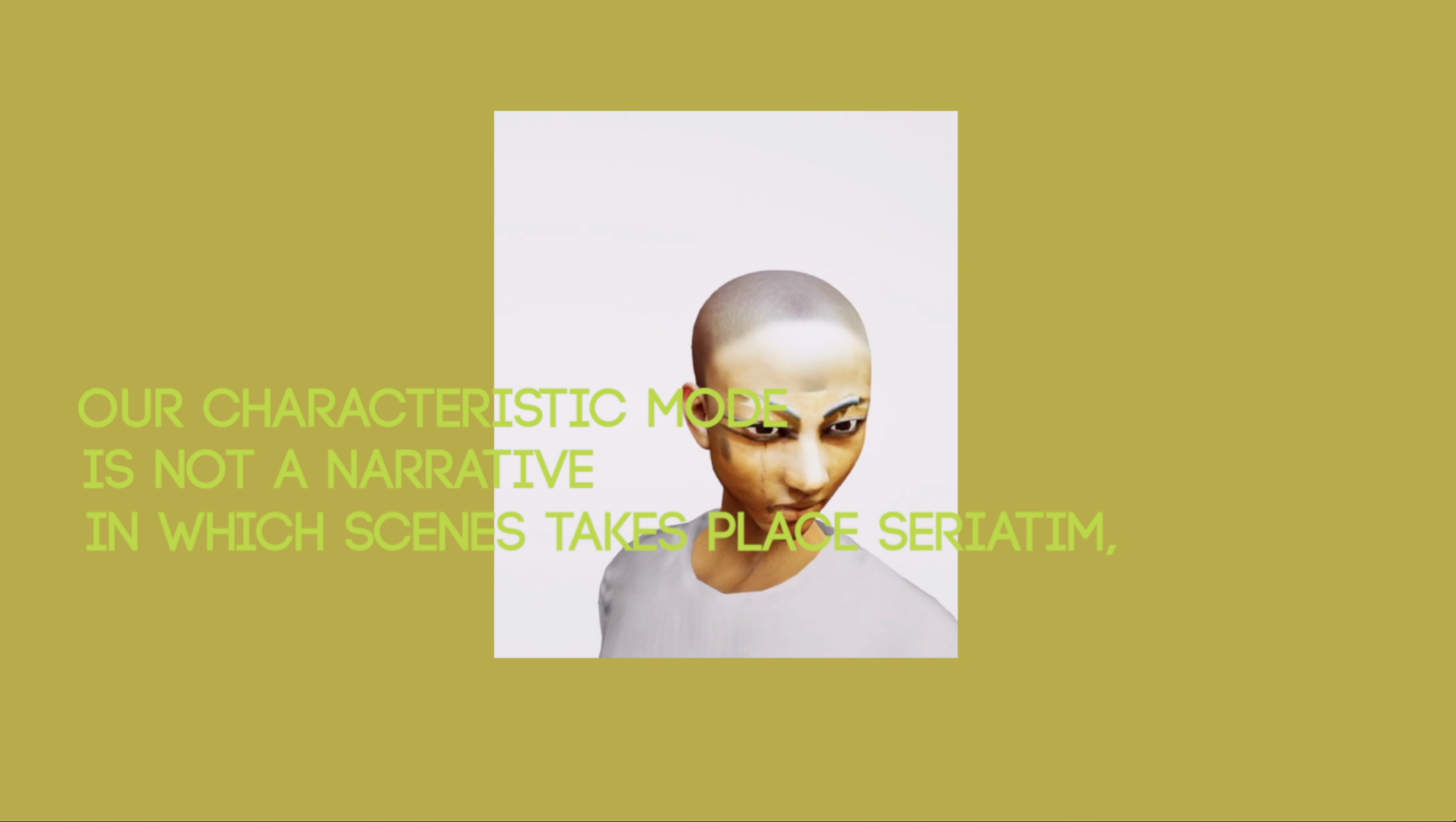

At those terrifying frontiers where the existence and disappearance of people fade into each other
Digital video, single channel version, 10:54 min, sound, 2019
And so our need for a new consciousness at those terrifying frontiers where the existence and disappearance of people fade into each other
-Edward Said, After the Last Sky (1986)
Fragments from Edward Said’s most personal and poetic work After the Last Sky are repurposed to create a new script that reflects on what it means now to be constructed as an ‘illegal’ person, body or entity. The script is turned into a song sung and performed by the artists as multiple avatars. Using a software that generates avatars from a single image the avatars in the video are all drawn from people who participated in the ‘March of Return’, that continue to take place on the seamline in Gaza, an area that has been under physical siege by the Israeli army since 2006. 40,000 people marched weekly to the military fence not only to break the siege but to be able to return to their villages and lands, protesters were killed, maimed and disabled week in and week out.
With the impossibility of the artists, who were also in Palestine, reaching the marchers and the marchers reaching them, the avatars that are created create a composite between the original images and the artist as the performers of the avatars only 100 km away. The work attempts to rupture this impossible imposed distance in an act of intense proximity and new becoming. The algorithm in the avatar software renders the missing data and information (due to the low resolution of images circulated online) in the original image as scars, glitches and incomplete features on the avatar’s faces. By keeping and not ‘fixing’ these visible scars the work speaks not only to the violence of the material reality but to the often invisible and embedded violence of representation itself in the circulation/consumption of images and ultimately to the violence in the algorithm. At those terrifying frontiers thinks about how to continue, how to mutate, in order not only to survive but to generate resistant possibilities of being and breathing within impossible conditions of violence and erasure.
Eshrat Erfanian
Waiting for Rostam
Digital video on Meta Quest 2, sound, 9 min, 2015/17
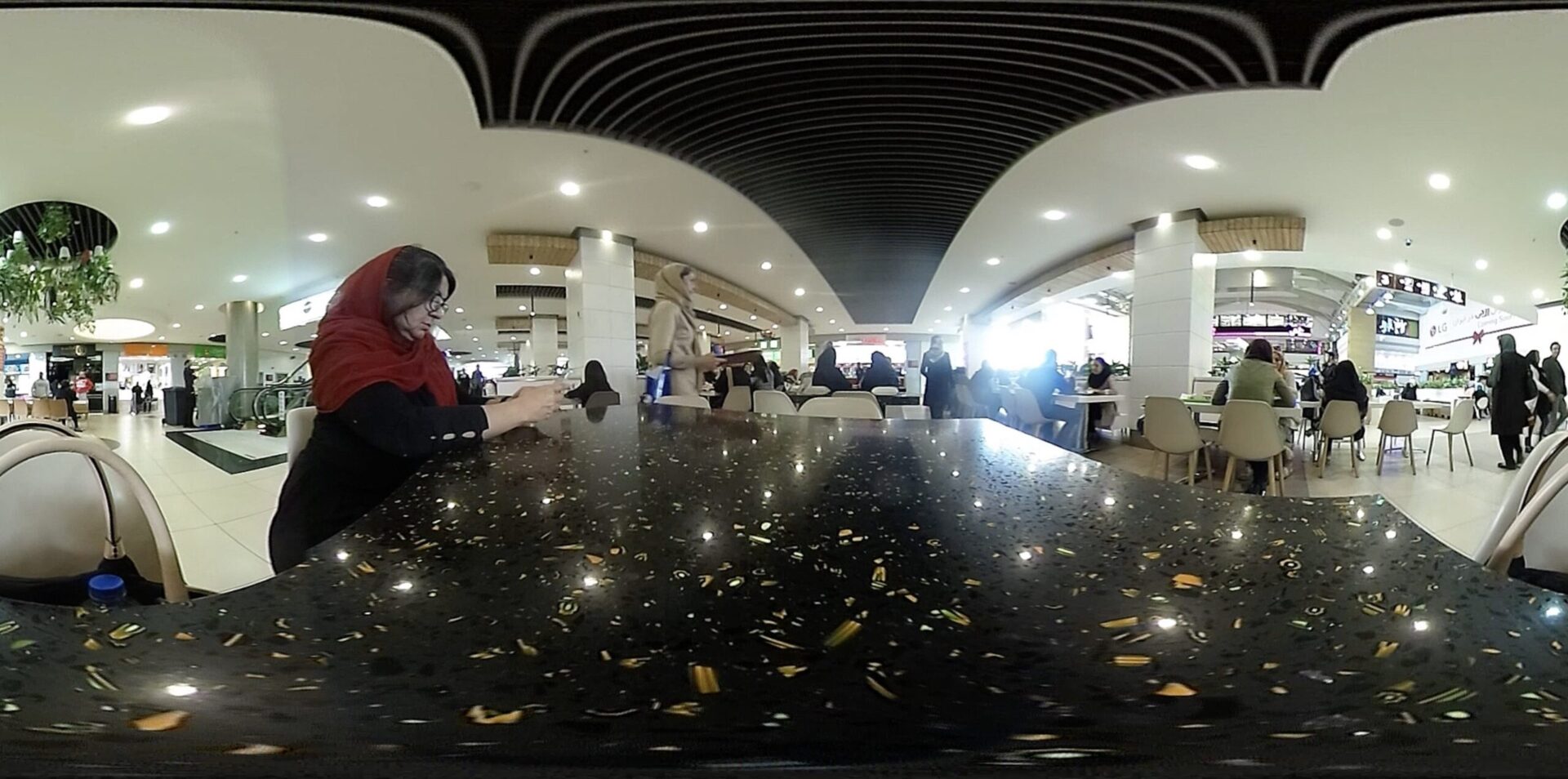
Eshrat Erfanian’s Waiting for Rostam is a nine minute 360 video, capturing the everyday in Iran. Panning from shopping malls to historic buildings and museums, Erfanian points at both old and new architectural landmarks, where generic subway stations and brand name malls contrast with 16th to 19th century palaces-turned-museums. With these images Erfanian brings the serenity and calm that she experienced during her 2016 visit to Tehran and Isfahan into 360-degree visual space, as a counter to hyperbolic and anxious popular images of Iran circulating in the west. Through this virtual tour, visitors are prompted to reflect on the ways digital colonization operates through architecture and content producers/ consumers.
Commissioned for Worldbuilding, 2015, Curators: John G. Hampton and Maiko Tanaka at Trinity Square Video
Editor: Andrew Cromey
Sound Designer: Zev Farber
Jenson Leonard
Workflow
Vinyl, digital video on screens and standing desk, 5:47 min, 2023
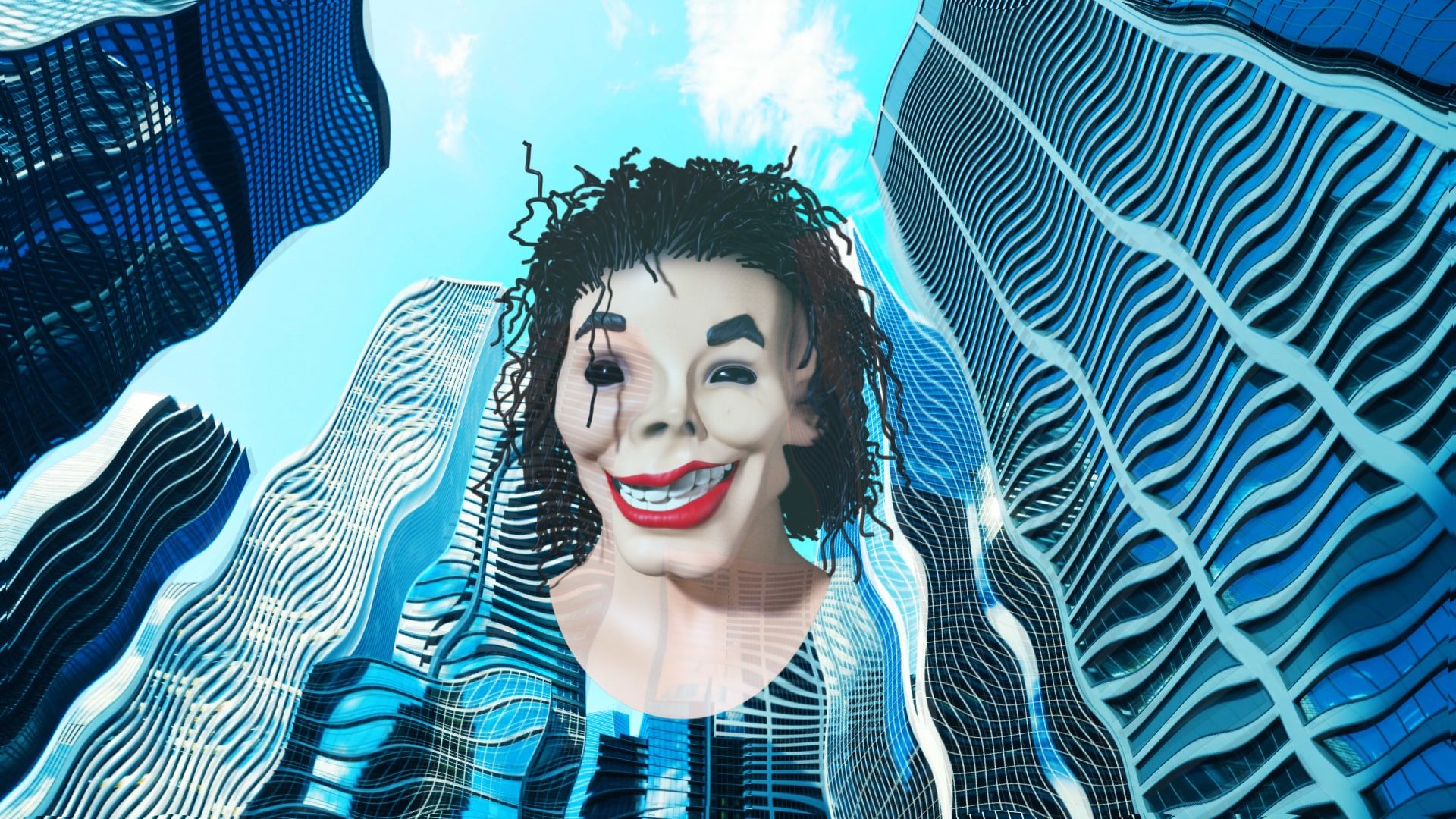
Workflow is a film that explores the velocity and momentum of Blackness as it relates to the philosophical concept of acceleration—the notion that the only way out of capitalism is through its intensification. In Workflow, a spectral Michael Jackson Halloween mask recites a surrealistic quarterly earnings reports. Building on a 2017 essay by artist Aria Dean titled “Notes on Blacceleration,” the short film centers on the ways in which the Black subject grapples with its commodified status within the labor market despite—or, resultant of—its own history as a commodity, stemming back to the Trans- Atlantic slave trade.
Kristin McWharter
RARA
Real time motion capture performance and software simulation, sound, 2020
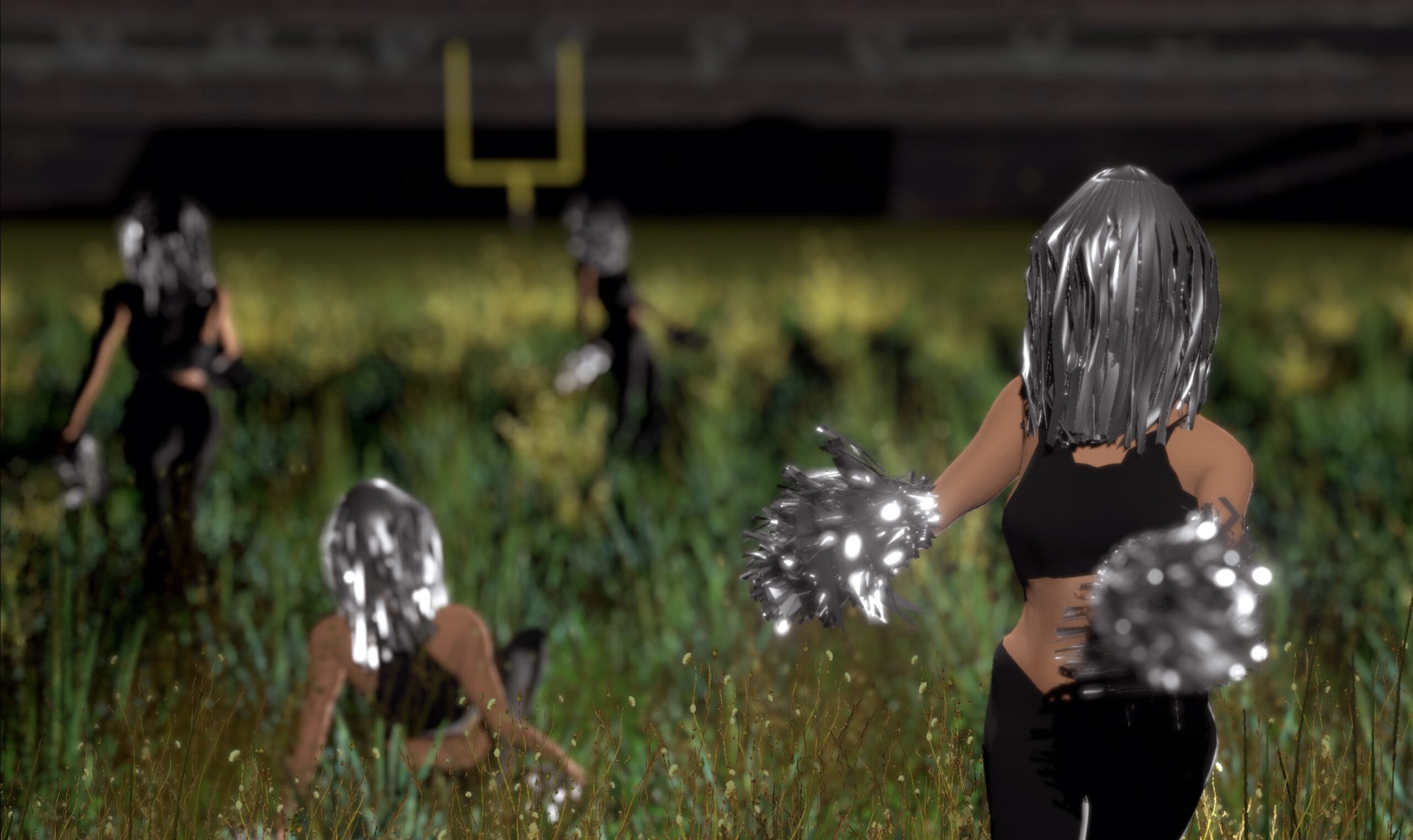
“After researching the history of the cheerleader archetype which emerged from fan cultures in the 20th century, I became interested in the salary disparity between professional cheerleaders and other public figures in the economy of prominent sport spectacles. I wanted to create a performance that would interrogate the narratives that inform how we value the participation of characters who play at the periphery of major athletic spectacles.
RARA is a performance that speculates on a future where the economic basis for professional sport entertainment has collapsed. The cheerleader, RARA, haunts a revolving landscape of abandoned arenas, motivated by her internal will to cheer. By using both real time motion capture and real time software simulation, this digital theater is performed live in the browser, continuously cheering on audiences at the rate of their internet speed.”
Leo Selvaggio
URME Mask, Paper, elastic bands, 2012
URME Mirror, Digital screen, webcam and MacMini with CablesGL., 2012
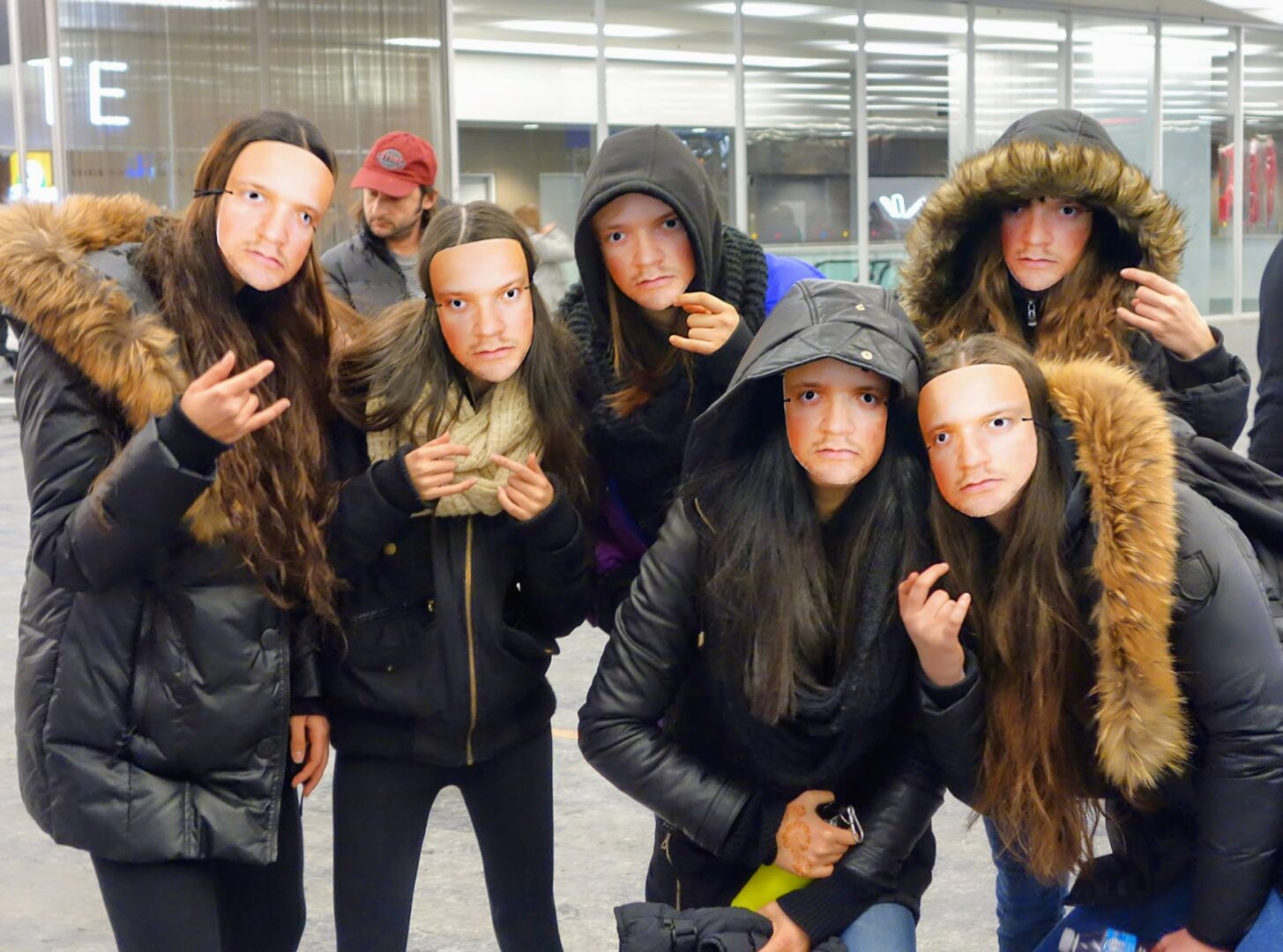
URME Mirror and URME Paper Mask are both extensions of URME Surveillance– a larger body of work in which the public is offered a 3D printed prosthetic of the artist’s face to wear in public spaces where facial recognition is active, thus protecting the wearer by attributing their actions as the artist’s own.
URME Mirror is an iterative technological translation of URME Surveillance’s core ideas into software, digitally replacing the viewer’s face on a live feed with that of the artist’s. At times an interactive installation, a mobile app, or a desktop interface for canned video, URME Mirror has changed drastically over the years and has been rebuilt on several different platforms. Its initial prototype was developed in 2012 using Max MSP and since then, URME Mirror has lived on Snapchat’s Lens Studio/Snap Cam, Instagram’s Spark Studio, 8thwall, and now Cables.GL.
URME Paper Mask was developed as a print-at-home kit to be a democratic multiple version of the 3D prosthetic. What the paper mask lacks in fidelity, it makes up for in proliferation, making them suitable for use by groups for activist and protest actions. Rather than the obfuscation offered by the prosthetic, URME Paper Mask invites wearers to participate in a mass visual spectacle of resistance their use by using the #URMEMask on social media.
Maggie Hazen and the Columbia Collective
Night Moth
Various media, 2019–present
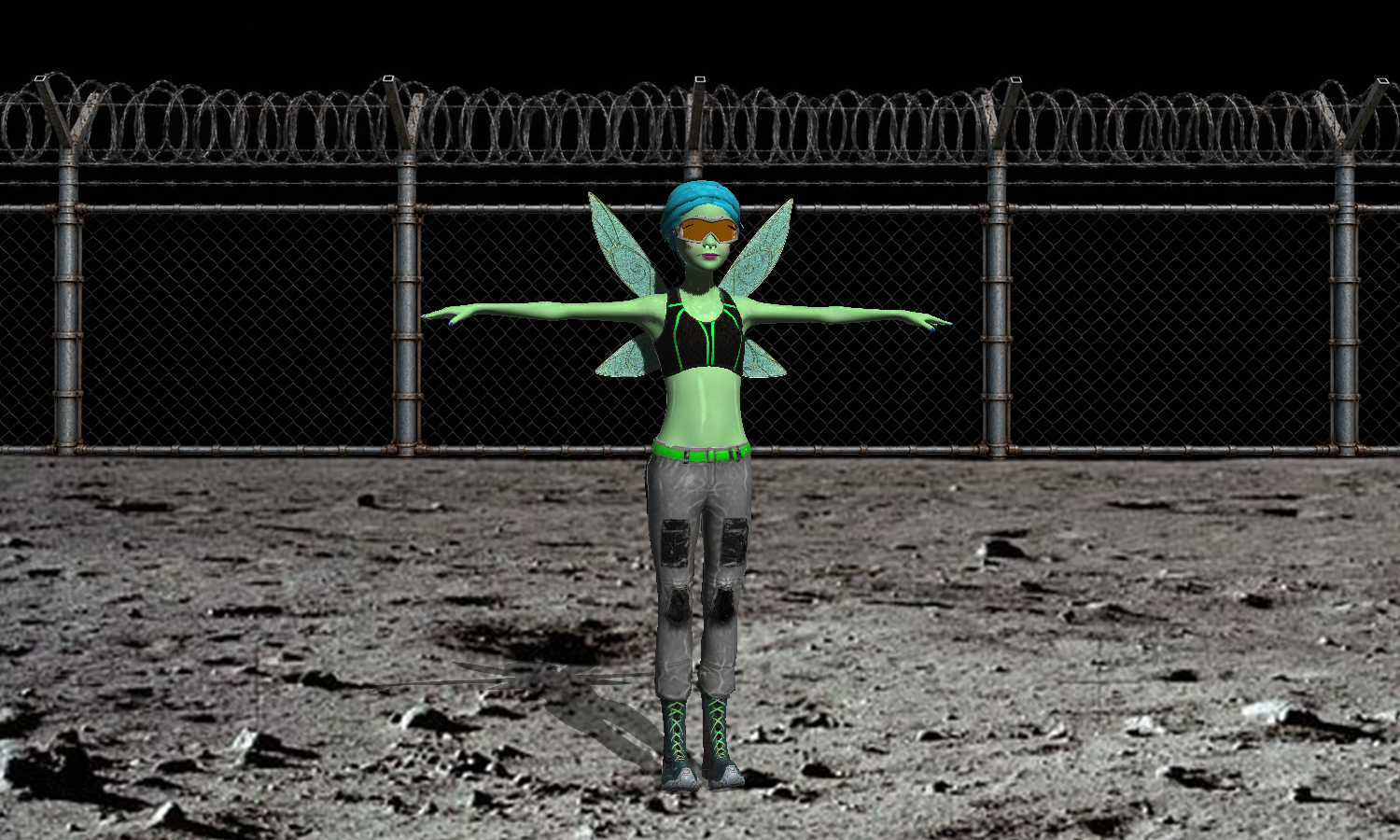
Night Moth is an ongoing collaborative project between artists Maggie Hazen and Danielle Webber that began in 2019 at the Columbia Secure Center for Girls, a now-closed maximum-security juvenile detention facility in New York’s Hudson Valley. Beginning with a shared sketchbook, the two began constructing an alternate universe centered around Luna, a teenage moth goddess banished to a prison on the moon. Conceived as Danielle’s avatar, Luna became a vehicle for navigating the boundaries between fiction and lived experience, creating space for self-representation, personal agency, and imaginative escape beyond the identities imposed by the carceral system. This installation brings together an evolving archive of drawings, research, ephemera, character studies, and early digital renderings that trace Luna’s development from an imagined figure into a virtual embodiment. Rather than presenting a completed narrative, the work reveals the collaborative process of world-building itself, exploring how fantasy and digital embodiment can become tools for reclaiming one’s own story.
Biographies of the artists
Basel Abbas and Ruanne Abou-Rahme work together across a range of sound, image, text, installation and performance practices. Their practice is engaged in the intersections between performativity, political imaginaries, the body and virtuality. Largely their approach has been one of sampling materials both existing and self-authored in the form of sound, image, text, objects and recasting them into altogether new ‘scripts’. The result is a practice that investigates the political, visceral, material possibilities of sound, image, text and site, taking on the form of multi-media installations and live sound/image performances.
The Columbia Collective is a collective of emerging female and trans artists with experiences of incarceration. Founded in 2019 at the Columbia Secure Center for Girls, a maximum-security juvenile facility in New York’s Hudson Valley, the collective emerged through collaborative artistic practice that challenged the institutional boundaries governing access, expression, and creative autonomy. Although the facility has since closed, the collective continues through a shared commitment to examining the conditions of confinement and imagining possibilities beyond them.
Eshrat Erfanian is an artist and educator. She was born in Tehran, Iran and lives and works in Toronto. Erfanian’s practice attempts to subvert the reading of images generated by the new technology. Her work ranges from video, video installation to digital photography and site-specific installations. Erfanian’s work has been exhibited in Jewish Museum in New York City, Incheon Biennale, numerous galleries in Ottawa, Montreal and Toronto. Her latest work has been permanently installed at the Immigration Hallway in the Canadian Embassy in Paris. Erfanian is an alumnus of the ISP Whitney Museum of American Art and holds a PhD from York University in Toronto.
Jenson Leonard (b. 1990, Detroit, Michigan) is an artist whose work emerges from the collapsed contexts of networked life. Working across moving image, digital collage, installation, and internet-based forms, his practice examines the circulation and mediation of images and the technological apparatuses that condition how they are produced, encountered, and understood. His work draws on the vernacular languages of the internet, popular culture, and computational media to consider how images move through and are transformed by platforms, interfaces, and computational systems of representation.
Leonard holds an MFA in Creative Writing from Pratt Institute and currently teaches in the Department of Media Study at the University at Buffalo. He has presented solo exhibitions at Pioneer Works, the Pittsburgh Cultural Trust, and the Hessel Museum of Art at Bard College. He has completed residencies at Obracadobra (Oaxaca, Mexico), Squeaky Wheel (Buffalo, NY), and Pioneer Works (Brooklyn, NY). His work has been featured in VICE Motherboard, Juxtapoz, AQNB, and Rhizome.
Kristin McWharter is an artist based in Chicago whose work investigates how social structures of play and power shape human connection. Through immersive installations, interactive encounters, and performance-based interventions, she creates spaces where audiences engage in the social choreography of competition— contesting, collaborating, and negotiating their roles in systems of dominance and desire. Rooted in the material and emotional landscapes of childhood games, pop culture, and virtual spaces, her practice explores how bodies, human and digital, navigate these spaces of contest and care. Using participatory frameworks, she crafts experiences that expose the tension between communal joy and competitive drive. Past projects working with prosthetic interfaces, real time computer simulation and performance have challenged social conditioning and offered glimpses of alternative modes of connection, where competition dissolves into something more tender, absurd, and speculative. In an era of increasing technological mediation, she is drawn to the friction between virtual and physical intimacy and her work prompts audiences to reconsider how power and play shape identity and perception.
Her work has been exhibited and performed internationally in major cultural institutions, artist run spaces, and media arts festivals. Venues have included Ars Electronica in Linz, Games as Art Festival in Tampere, Hyde Park Arts Center in Chicago, The Hammer Museum and Walt Disney Concert Hall in Los Angeles, Bangkok Arts and Cultural Center, Museo Altillo Beni in Santa Cruz de la Sierra, Voltaje in Bogotá and FILE Festival in São Paulo among many others. McWharter is currently an Associate Professor in Art & Technology / Sound Practices at the School of the Art Institute of Chicago.
Leo Selvaggio, born 11/06/1984, is an Interdisciplinary Artist and Designer whose work examines the entanglement of identity with technology within the context of civic action. He has exhibited in France, Canada, Switzerland, the Netherlands and broadly in the US. Selvaggio’s work has been featured in Businessweek, Hyperallergic, Techcrunch, The Washington Post, CNET, The Verge, Brut America, as well being optioned for television. His work is included in various collections including the Spy Museum and the Wende Museum in the US. Selvaggio’s writing can be found in several publications, including the International Journal for Performance Arts‘ and the recent book, The Evolution of the Image: Political Action and the Digital Self. He holds a BFA from Rutgers University and an MFA from Columbia College’s Interdisciplinary Arts program. He currently serves as a Creative Technologist for the Creative Arts and Technology Spaces at Brown University.
Maggie Hazen is a Los Angeles–based visual artist working across sculpture, moving image, and community practice. Her work has been exhibited, screened, and performed at the Bronx Museum, Brooklyn Museum, Museum of Tolerance, Granoff Center at Brown University, Pulse Miami Beach as part of Pulse Play, and the Center for Photography at the University of California, Riverside as part of Southern California’s Pacific Standard Time; among others.
Public works include Hidden in Plein Site, a billboard about carceral landscapes in the Catskill Mountains, Transmimic, a projection on the Manhattan Bridge, and Of Departed Delineations, a transformative memory commemorating the 1992 LA Riots. Her work has been included in group exhibitions at venues throughout the United States and internationally, including New York, Los Angeles, Washington DC, Korea, Taiwan, Turkey, and Philadelphia.
Hazen has had fellowships, grants, and residencies from The Foundation for Contemporary Art, Pioneer Works, AIM Fellowship at the Bronx Museum, Squeaky Wheel Film & Media Arts Center, New York State Council on the Arts/Wave Farm’s Lighthouse Works, Vermont Studio Center and the Saas-Fee Summer Institute of Art in Switzerland; and many others.
She has taught at Bard College, New York University, the Rhode Island School of Design, Stevens Institute of Technology, and the Shanghai Institute of Visual Art. She has studied at Brown University, MIT, and the European Graduate School. She holds a BFA from Biola University in California and an MFA from the Rhode Island School of Design.