

- This event has passed.
Chris Marker’s The Case of the Grinning Cat, with short films by Serge Avedikian and Wiame Haddad
Wednesday, August 5, 2026, 7 pm
Free or suggested donation
In-person at Squeaky Wheel and online
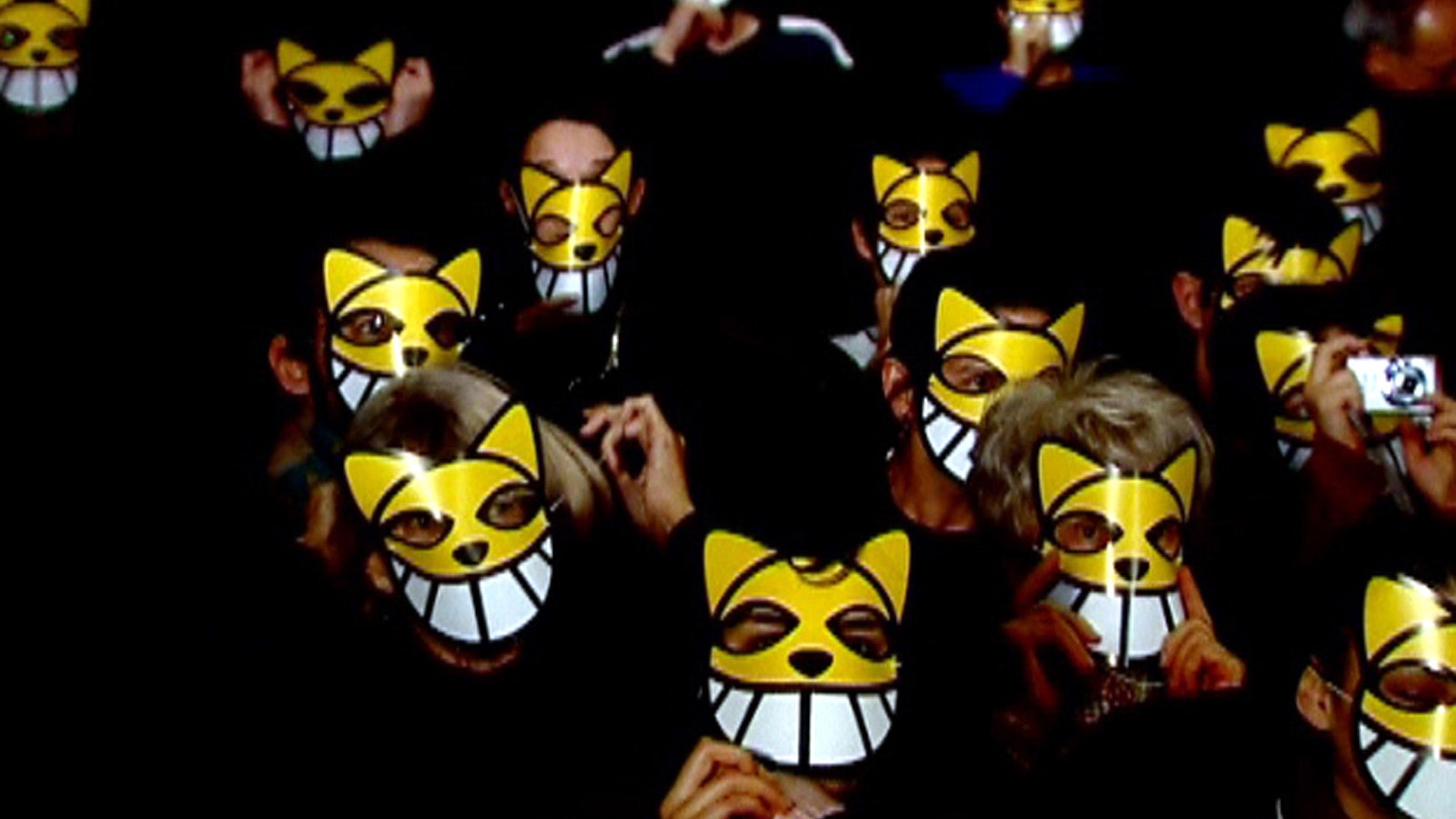
Squeaky Wheel presents a screening of Chris Marker’s iconic film, Chat Perchés (The Case of the Grinning Cat), preceded by Serge Avedikian’s haunting short animated film, Chienne D’histoire (Howling Island) and Wiame Haddad’s subtle and urgent film Sang Titre. The films think through past and current history with and through animals, and depictions thereof: Avedikian’s Barking Island tells the story of the 1910 dog exile and massacre in Ottoman Istanbul, where thousands of dogs were rounded up and sent to a nearby Island to die, with clear resonances between the event and the Armenian Genocide. Meanwhile in The Case of the Grinning Cat, Chris Marker reflects on French and international politics, art and culture at the start of the new millennium through the sudden appearance of alluring portraits of grinning yellow cats through Paris.
The screening is presented as part of our exhibition, With us at the center of our world: Animals, domestications, dreams. The exhibition presents the work of nine artists thinking through and on non-human animals. The artists – working in animation, essay films, speculative narratives, installation work, among other forms – address topics of domestication, colonialism, extinction, and conservation, and the toll humans extract from our co-inhabitants on earth. The exhibition features work by Amy Ching-Yan Lam, Annika Eriksson, Cameron A. Granger, Christina Corfield, Deniz Tortum & Sister Sylvester, G. Anthony Svatek, Miranda Javid, and Noor Abuarafeh.
For in-person attendees: The event will take place at Squeaky Wheel. Please note that you cannot enter Tri-Main Center after 7:30 pm. Samosas from Ali Baba Kebab will be provided.
For online attendees: A private link will be sent to you; the event will be available at the link at the start date and time. You will have access to the event for 24 hours; Squeaky Wheel members receive 72 hour access. Not a member yet? Sign up here.
This event is supported by Teiger Foundation and the Andy Warhol Foundation for the Visual Arts. Special thank you to Bob Hunter at Icarus Films, Luigi Loy at Sacrebleu Productions, and Salome Kokoladze and Aurora Picture Show.
Program
Total program duration is ~76 minutes
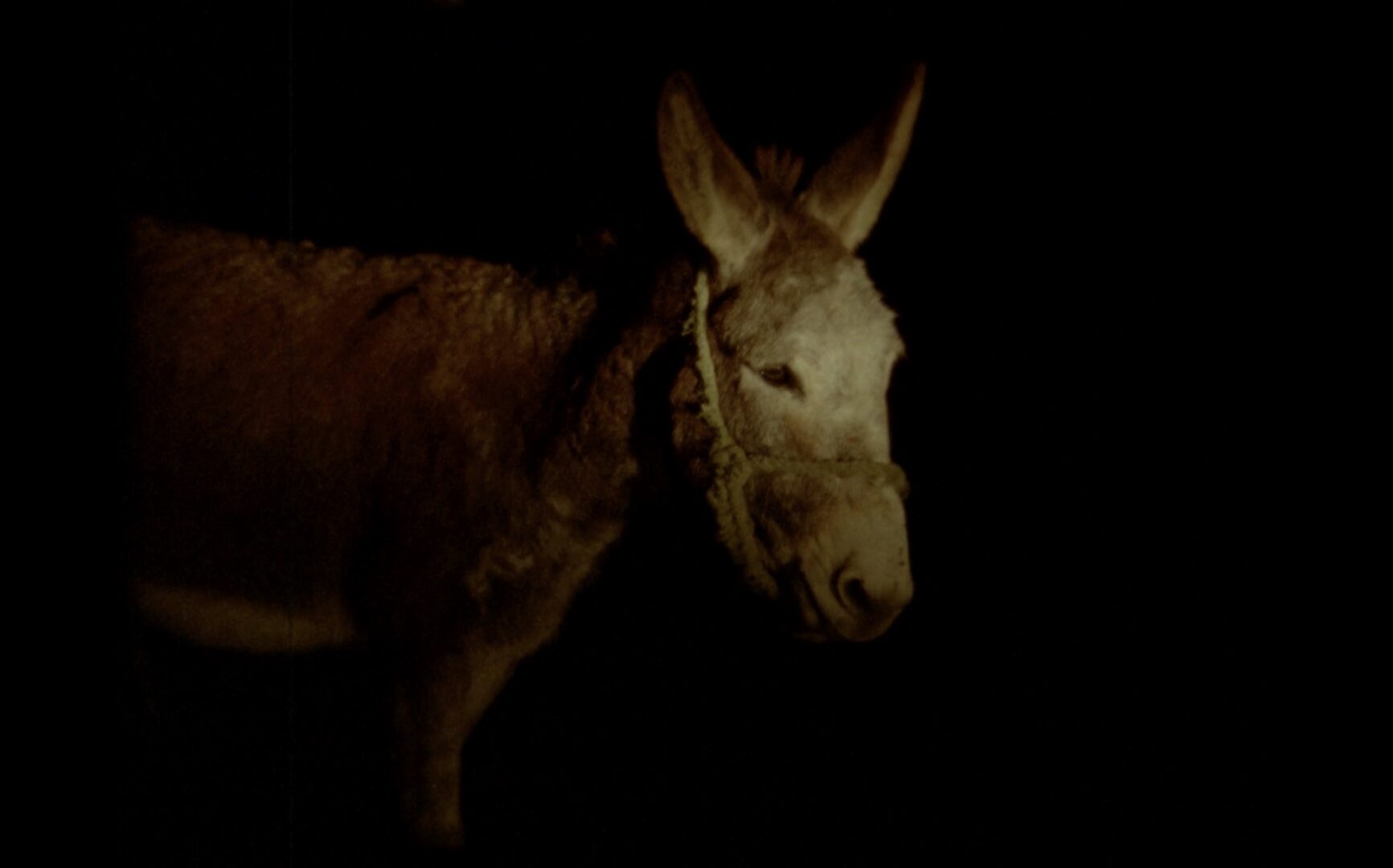
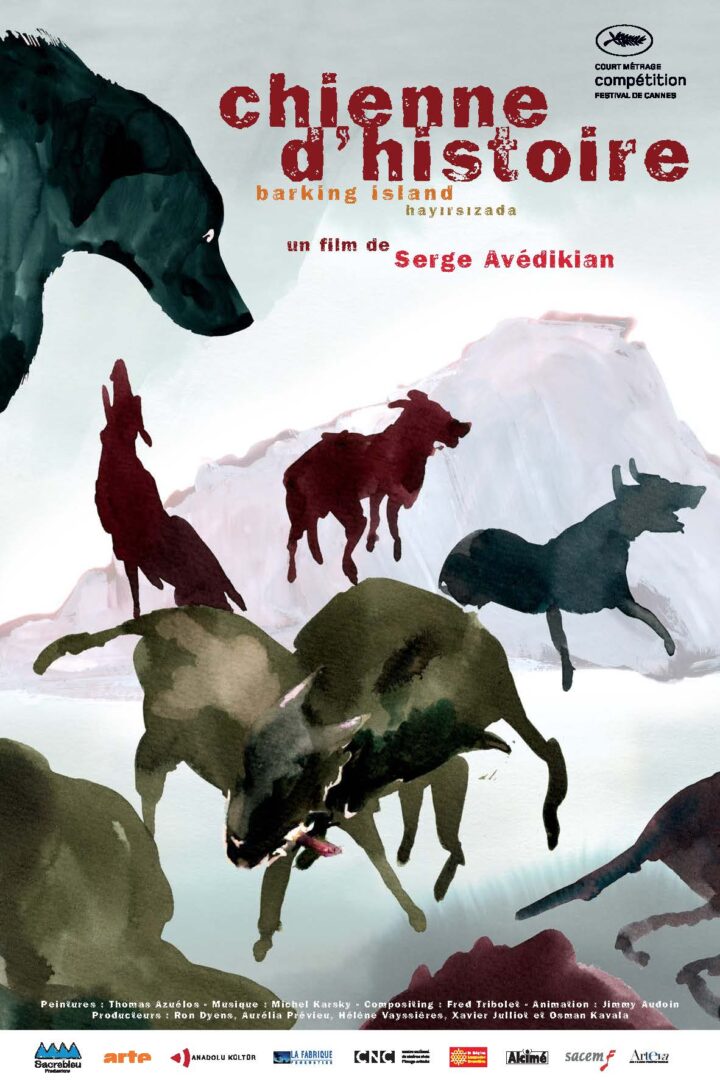
Left to right: Wiame Haddad, Sang Titre (2024); the poster of Serge Avédikian, Chienne D’histoire (Howling Island) (2010); Chris Marker, The Case of the Grinning Cat (2004).
Serge Avédikian, Chienne D’histoire (Howling Island)
15 minutes, 2010
Constantinople 1910. Too many stray dogs in the streets of the city. The new government, influenced by a Western model of society, looks to European experts for ways to get rid of them before deciding, alone, to finally deport 30,000 dogs to a deserted island off the coast of the city. Through the dual eyes of a dog who has just given birth and the policeman who cages her, we follow the forced exile of these dogs, most of whom will die of hunger and thirst, to the great satisfaction of the authorities. Years later, in an alley of the city, our rescued dog will find her gendarme, who has become blind…. Description and film courtesy of Sacrebleu Productions. Written by Serge Avédikian & Karine Mazloumian. Composer Michel Karsky.
Wiame Haddad, Sang Titre
2:55 minutes, 16 mm on digital video, 2024
Sang Titre is an evocation of a post-twilight, where the echo of an absolute, indomitable, and profound resilience resonates. Borrowing its title from Godard and Miéville, this film emerges from a surge of anger and despair in
the face of the ongoing violence endured by Palestinians. Rooted in both urgency and mourning, it echoes a long history of oppression while seeking a visual language to confront it. At its core lies a nocturnal encounter with a donkey, suddenly appearing in the darkness—resilient, bound, and silently accusatory. Its piercing gaze, both gentle and unyielding, becomes a powerful allegory of dignity, resistance, and the enduring condition of oppressed peoples.
The film was created following an invitation from Narimane Mari as part of the project Some Strings, which brings together filmmakers to engage with Palestine. The project has been presented in numerous institutions and festivals around the world, and continues to evolve.
Chris Marker, The Case of the Grinning Cat
58 minutes, 2004
French documentarian and cinema-essayist Chris Marker reflects on French and international politics, art and culture at the start of the new millennium. In November 2001, the filmmaker became intrigued, as did many other Parisians, by the sudden appearance of alluring portraits of grinning yellow cats on buildings, Metro walls and other public surfaces. Marker’s cinematic efforts to document the mysterious materializations of this charming feline throughout Paris are a recurring theme of The Case of the Grinning Cat.
This engaging record of Marker’s cinematic peregrinations throughout the city, visually energized by his free-association montage style, chronicles strikes, demonstrations, memorials, election campaigns, celebrity scandals, international political incidents, and a seemingly endless variety of political protests (against the Iraq War, against China’s occupation of Tibet, against the government’s ban on the wearing of Muslim headscarves). The personalized commentary running throughout The Case of the Grinning Cat offers the simultaneously learned and witty reflections of the filmmaker, now in his early eighties, on both the contemporary and historical implications of these varied events and personalities.
The mysterious grinning yellow cats soon begin to appear amidst the banners and signs in some of the political demonstrations. Eventually, the creator of the grinning cats is revealed to be an art collective known as Mr. Cat, whose members are shown painting a massive representation of their mascot on the plaza before the Pompidou Center. The filmmaker’s own famous cat caricature soon allies with Mr. Cat, as Marker speculates on the political possibilities of such a feline association.
Chris Marker concludes The Case of the Grinning Cat with thoughts on the vital importance of such expressions of imagination in our public lives, echoing the May ’68 slogan that “”La poésie est dans la rue”” (“”Poetry is in the street””). Description and film courtesy of Icarus Films.
Biographies of the artists
Serge Avédikian was a student at the Conservatory of Dramatic Art of Meudon, then worked with the students of the Paris Conservatoire and acted in numerous plays from the classical and modern repertoire. In 1976, he created a theater company and directed several plays. In 1982, he began directing documentary films, while continuing his work as an actor in cinema and theater. In 1988, he founded his own production company and directed personal films. At the same time, he continued his career as an actor in theater, film and television. Since 2000, he has devoted more time to acting in theater and film and continues to direct films with other producers.
Born Christian François Bouche-Villeneuve on July 29, 1921 in Neuilly-sur-Seine, France, Chris Marker was a cinematic essayist and audio-visual poet. After the Second World War, Marker began as a writer, publishing his first book in 1949. In the 1950s he turned to documentary filmmaking. Among his classic works from this period are Letter from Siberia, Cuba Si!, Le Joli Mai, and La Jetée. In the ’60s and ’70s he was actively involved with SLON, a filmmaking collective dedicated to activist production. Marker reemerged to make films under his own name again in 1977 with Le Fond de l’air est rouge (English title: A Grin Without A Cat). Creatively reworking his life as if editing one of his own films, Marker made films on other filmmakers during the ’80s and ’90s, including the renowned One Day in the Life of Andrei Arsenevich. He also explored video and computer-generated imagery with a continued emphasis on the intersection between personal and political themes in films such as The Case of the Grinning Cat, which was released in English in 2006. A pioneer auteur filmmaker and an original voice in world cinema for over 50 years, Marker passed away on his birthday, July 29, 2012. He is widely accepted to be one of the most innovative and influential filmmakers in modern cinema history. (Biography via Icarus Films)
Wiame Haddad works within an extended temporal framework. She develops her practice through series, each emerging from deeply researched investigations, both theoretical and formal. The images she produces are rare and deliberately sparse — a remarkable approach within contemporary photographic and cinematic practices often driven by constant flux and overproduction. Born in 1987 in Lille, Wiame Haddad graduated from the ESAD of Valenciennes and from La Cambre National School of Visual Arts in Brussels. She develops visual projects that engage with the tensions of the body as a political signifier. This research is coupled with an attraction toward what remains unseen. The artist focuses on bodies and events forgotten by History, particularly on the representation of collective memory and its omissions. Her work is also rooted in an anti-colonial approach, questioning and deconstructing representations inherited from imperial history. Through the invention of forms, the recreation of images, and the construction of new visual archives, she seeks to sketch out alternative narratives capable of displacing and rewriting dominant versions of colonial history. She lives and works in Paris. Her work has been presented in numerous exhibitions, notably at the Les Rencontres de la Photographie d’Arles, the CRAC Occitanie, Villa Empain – Fondation Boghossian, and the MACAAL, among others. She has also participated in various film festivals including Cinéma du Réel — where she received a Special Jury Mention — Toronto International Film Festival, Open City Documentary Festival, and Tout Court – Nuove Voci della Cineteca di Bologna.
